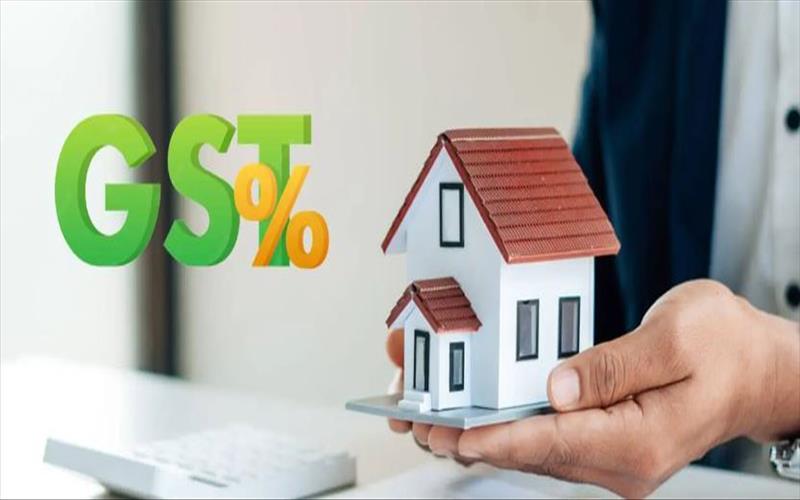
Date : 30/04/2025 |
In India Home buyer is liable to pay GST ? must be know before paying it.
In India, the liability to pay Goods and Services Tax (GST)
on the purchase of a property depends on the type of property, its stage of
construction, and specific regulations under the GST framework.
Below is a detailed explanation of whether the home buyer or the developer is liable to pay GST, along with the nuances of the system:
1. GST Applicability
on Property Transactions:-
GST is applicable on the sale of under-construction properties or ready-to-move-in properties where the completion certificate has not yet been issued. However, GST does not apply to the sale of completed properties (Ex. properties with a completion certificate or occupancy certificate issued by the competent authority).
B. Completed properties: Once a completion certificate is issued, the property is considered a "completed" property, and its sale is treated as a sale of immovable property, which is outside the purview of GST. Instead, stamp duty and registration charges may apply.
3. Who is Liable to Pay GST?
The developer or builder is primarily responsible for collecting and remitting GST to the government. However, in practice, the home buyer bears the cost of GST as it is included in the property price quoted by the developer.
- The developer is registered under GST and is responsible for charging GST on the sale of under-construction properties.
- The developer collects GST from the home buyer as part of the payment for the property and deposits it with the government.
- The developer issues a GST invoice to the home buyer, reflecting the GST component.
- The home buyer does not directly pay GST to the government. Instead, they pay the GST-inclusive price to the developer.
- The GST amount is embedded in the total cost of the property, and the buyer indirectly bears the tax burden.
4. GST Rates on
Residential Properties:-
The GST rates for residential properties were simplified in 2019 by the GST Council to make housing more affordable. The applicable rates (as of the latest updates) are:
- Definition: Residential properties with a carpet area of up to 60 square meters in metro cities (Delhi, Mumbai, Kolkata, Chennai, Bengaluru, Hyderabad) or 90 square meters in non-metro cities, and a value of up to ₹45 lakh.
- GST Rate: 1% (without Input Tax Credit, ITC, for developers).
- Non-Affordable Housing :-
- Definition: Properties that do not fall under the affordable housing category (e.g., higher value or larger carpet area).
- GST Rate: 5% (without ITC for developers).
- Commercial Properties :-
- GST Rate: 12% (with ITC, depending on the project).
- No ITC for Developers : For residential properties (affordable and non-affordable) under the new scheme, developers cannot claim Input Tax Credit (ITC) on the GST paid on raw materials, services, or other inputs used in construction. This was done to keep GST rates low for home buyers.
- GST on Advance Payments : If a home buyer makes an advance payment to the developer for an under-construction property, GST is applicable on the advance amount at the time of payment.
- No GST on Land : GST is not levied on the land component of the property. However, to calculate GST, the value of the land is typically deemed to be one-third of the total property value, and GST is applied only on the remaining two-thirds (construction value).
Suppose a home buyer purchases an under-construction flat worth ₹60 lakh (excluding GST):
- Land value = ₹60 lakh × 1/3 = ₹20 lakh.
- Taxable value (construction cost) = ₹60 lakh - ₹20 lakh = ₹40 lakh.
- If the flat is non-affordable (5% GST):
- GST = ₹40 lakh × 5% = ₹2 lakh.
- If the flat qualifies as affordable housing (1% GST):
- GST = ₹40 lakh × 1% = ₹40,000.
- Step 3 : Total cost to the buyer.
- Non-affordable: ₹60 lakh + ₹2 lakh = ₹62 lakh.
- Affordable: ₹60 lakh + ₹40,000 = ₹60.4 lakh.
The developer collects the total amount (including GST) from the buyer and remits the GST portion (₹2 lakh or ₹40,000) to the government.
- Resale of Properties : GST does not apply to the resale of properties (whether under-construction or completed) by individuals, as it is not considered a supply of goods or services under GST law.
- Government Housing Schemes : Certain government-backed affordable housing schemes (e.g., Pradhan Mantri Awas Yojana) may have additional exemptions or subsidies, reducing the effective GST burden.
- Works Contract Services : If a buyer directly engages a contractor for construction (e.g., building a house on their own land), GST applies to the works contract at 18%. In such cases, the contractor charges GST, and the buyer bears the cost.
In addition to GST, home buyers are liable to pay:
- Stamp Duty: - Levied by state governments on the property’s value (typically 5-7% of the property value, varying by state).
- Registration Charges: - A fee for registering the property (usually 1% of the property value or a fixed amount, depending on the state).
- These are separate from GST and are paid directly to the state government.
- Check Completion Status: - If the property has a completion certificate, no GST is applicable, which can reduce the overall cost.
- Verify GST Inclusion: - Ensure the developer clearly mentions the GST component in the agreement and provides a GST invoice.
- Affordable Housing Benefits: -If the property qualifies as affordable housing, the lower GST rate (1%) can significantly reduce costs.
- Transparency: - Home buyers should confirm whether the quoted price is inclusive or exclusive of GST to avoid surprises.
- GST Registration :- Developers with an annual turnover exceeding ₹20 lakh (or ₹10 lakh in special category states) must register for GST.
- Compliance :- Developers must file GST returns and deposit the collected GST with the government.
- No Hidden Charges : -Developers cannot charge GST over and above the prescribed rates or include it in a manner that misleads buyers.
In summary, while the developer is legally responsible for collecting and remitting GST to the government, the home buyer effectively bears the GST cost as it is included in the property price.
GST applies only to under-construction properties or properties without a completion certificate, at rates of 1% (affordable housing) or 5% (non-affordable housing) without ITC for developers.
Home buyers should carefully review the agreement, ensure transparency in pricing, and verify the property’s status to understand their tax obligations. For completed properties, buyers are exempt from GST but must pay stamp duty and registration charges.
If you have a specific scenario or need further clarification, please contact with any expert consultant to more details.
Disclaimer
The 85inches Realty clearly disclaims all liability in respect to actions taken or not taken based on any or all the contents of this Blog. The content of this blog is collation of data from various sources and is provided only for information purpose only and 85inches Realty does not canvass the particulars, information, brand or any other materials mentioned in the blogs nor does it obtain any monetary benefit from the same.The 85inches Realty shall in no circumstance be held liable for any expense, loss or damage including, without limitation, direct, indirect or consequential loss or damage, or any other expense, loss or damage whatsoever arising from the use of data, information, interpretation, judgement or opinion arising out of or in connection with the use of this Blog. Reader is advised to read and apply his/ her intellect and discretion in this regards.
Recent Blog




Popular Blog
The Impact of Infrastructure Development on Varanasi Real Estate ?
15/04/2025 | 1997

Why do you need to take home inspection services before buying it ?
15/04/2025 | 1956
How can housing societies tackle non-payment of maintenance charges?
16/06/2025 | 1858