Date : 30/10/2026 |
NCLT vs RERA : Where Should a Stranded Homebuyer Go First ?
Buying a home is one of the most significant financial decisions a person makes. For many families, it represents years of savings, financial commitments, and the dream of owning a secure home. Unfortunately, thousands of homebuyers face problems such as delayed possession, stalled construction, builders refusing refunds, incomplete projects, and financial distress within real estate companies.
When a developer fails to deliver a promised home, an important question arises: Should a stranded homebuyer approach NCLT or RERA first?
The answer depends on the nature of the dispute, the financial condition of the builder and the relief the homebuyer wants.
In many ordinary possession and refund disputes, RERA is a practical starting point. However, where a corporate developer is insolvent or the project faces severe financial distress, proceedings before the National Company Law Tribunal (NCLT) under the Insolvency and Bankruptcy Code (IBC) may also be relevant.
In this comprehensive guide, 85Inches Realty PVT.LTD explains the differences between NCLT and RERA, the legal options available to homebuyers, and the factors to consider before choosing a course of action.
1. What Is RERA and How Does It Protect Homebuyers ?
The Real Estate (Regulation and Development) Act, 2016, commonly known as RERA, was introduced to improve transparency, accountability, and consumer protection in the real estate sector.
Under the Act, state-level Real Estate Regulatory Authorities address complaints and enforce applicable obligations of developers.
RERA provides important protections to homebuyers, subject to the applicable provisions and facts of each case.
When Should a Homebuyer Approach RERA?
· A complaint before the relevant RERA authority may be appropriate when:
· The builder has delayed possession beyond the agreed date.
· The developer has failed to fulfill contractual or statutory obligations.
· The homebuyer seeks possession of the booked property.
· The buyer seeks a refund with applicable interest.
· The developer has made misleading representations concerning the project.
· The project involves relevant violations of RERA requirements.
· The builder has deviated from sanctioned plans or applicable project specifications.
· The precise relief depends on the nature of the violation, the agreement, and the authority's jurisdiction.
Can RERA Help a Homebuyer Get a Refund?
Yes, in appropriate cases.
Section 18 of the RERA Act addresses the promoter's liability when the promoter fails to complete a project or is unable to give possession in accordance with the agreement or the circumstances specified by law.
Depending on the circumstances, an allottee may be entitled to -
A refund of the amount paid, with applicable interest and compensation as provided by law, where the allottee is entitled to withdraw and Interest for each month of delay until possession, where the allottee does not intend to withdraw and the statutory conditions are satisfied.
Other relief available under the Act -
Homebuyers should carefully assess whether seeking possession or withdrawing for a refund is more appropriate for their circumstances.
2. What Is NCLT and When Does It Become Relevant?
The National Company Law Tribunal, or NCLT, is a specialized tribunal dealing with matters assigned to it under company law and insolvency legislation, For stranded homebuyers, one important route is the Corporate Insolvency Resolution Process (CIRP) under the Insolvency and Bankruptcy Code, 2016.
Under the IBC, qualifying homebuyers are recognized as financial creditors of a corporate real estate developer , This means that eligible homebuyers may be able to initiate insolvency proceedings against a defaulting corporate developer, provided the statutory requirements are met.
When Should Homebuyers Consider NCLT?
NCLT proceedings under the IBC may deserve consideration when -
· Construction has stopped for an extended period.
· The developer is experiencing serious financial distress.
· The company has defaulted on financial obligations.
· Multiple homebuyers are affected by a stalled project.
· There are concerns about the developer's ability to complete the project.
· Ordinary remedies may not adequately address the wider insolvency problem.
However, a delayed possession date alone does not automatically establish a suitable case for insolvency proceedings.
The existence of a legally relevant default, the identity of the corporate debtor, the statutory threshold, and other applicable requirements must be assessed.
Note: NCLT Is Not Simply a Refund Court -
Homebuyers sometimes assume that approaching NCLT will automatically result in a refund, That is not how insolvency law works.
The objective of CIRP is to resolve the insolvency of the corporate debtor through the statutory process. Depending on the circumstances, the process may lead to a resolution plan or other outcomes permitted by law.
Neither full repayment nor timely possession is guaranteed.
Before initiating insolvency proceedings, homebuyers should understand the potential consequences for the project, their claims, and their preferred outcome.
The buyer's statutory rights and the developer's obligations, Whether insolvency proceedings are justified and legally maintainable .
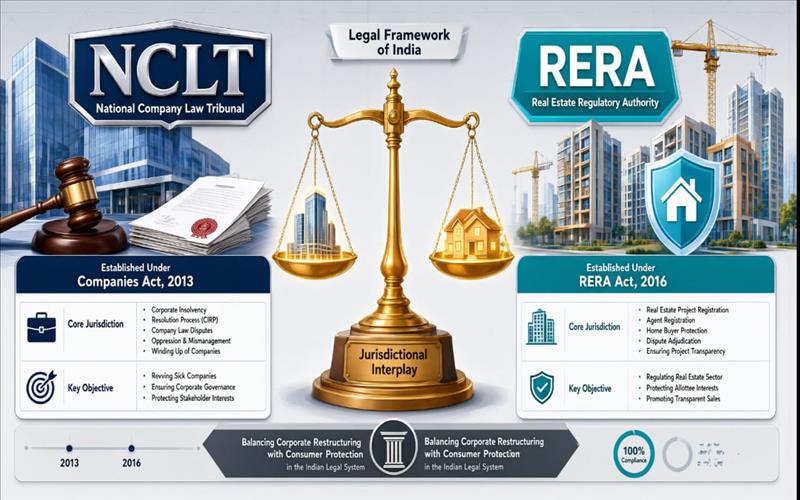
The key distinction: RERA focuses on real estate regulation and allottee remedies, while NCLT under the IBC deals with the insolvency resolution of a corporate debtor.
The two legal frameworks can provide concurrent remedies, although the effect of ongoing insolvency proceedings must be examined carefully.
4. Can a Homebuyer Approach Both NCLT and RERA?
Yes, potentially, The Supreme Court of India addressed the relationship between RERA and the IBC in Pioneer Urban Land and Infrastructure Ltd. v. Union of India (2019), The judgment recognized that the remedies available to homebuyers under RERA and the IBC can operate concurrently.
However, this does not mean every homebuyer should initiate proceedings in both forums simultaneously, The appropriate strategy depends on the facts, the relief sought, and the procedural stage of each case.
Before proceeding, homebuyers should consider:
· Whether a RERA complaint has already been filed.
· Whether a refund or compensation order has been issued.
· Whether insolvency proceedings against the developer have commenced.
· Whether a moratorium under Section 14 of the IBC is in force.
· Whether the proposed claim can proceed in light of the insolvency process.
· Whether the buyer's objective is possession, a refund, or project-wide resolution.
Practical advice: Obtain case-specific legal advice before initiating parallel proceedings, particularly when an insolvency case has already been admitted.
5. Where Should a Stranded Homebuyer Go First?
There is no universal answer. The following scenarios provide a practical starting point.
Scenario A: The Builder Is Delaying Possession -
Suppose a buyer booked a flat for ₹60 lakh, paid ₹45 lakh, and the builder failed to deliver possession by the agreed date.
If the buyer wants possession or a legally available refund, a complaint before the relevant RERA authority may be an appropriate first step.
The buyer should review the agreement, promised possession date, payment receipts, project registration, and current construction status.
Scenario B: The Builder Has Abandoned the Project -
Suppose construction has stopped, contractors have left the site, and numerous homebuyers are waiting for possession.
The buyer should investigate the project's financial and legal status.
RERA may remain relevant to individual allottee remedies. If there is evidence of corporate insolvency, homebuyers may also consider whether an IBC application is appropriate.
The statutory requirements for initiating insolvency proceedings must be satisfied.
Scenario C: The Builder Is Unable to Repay Homebuyers -
A developer may face substantial debts and lack the resources to repay buyers individually.
In this situation, homebuyers should assess the prospects of recovery, the company's financial condition, and whether insolvency proceedings are already pending.
An insolvency professional or lawyer experienced in IBC matters can help evaluate the available options.
Scenario D: The Builder Has Violated Project Approvals -
Suppose the developer has made unauthorized changes to the project, failed to follow sanctioned plans, or violated applicable regulatory requirements.
Depending on the violation, the homebuyer may need to approach RERA, the competent development authority, or another appropriate forum.
If the facts indicate cheating, forgery, or another criminal offence, a police complaint may also be relevant, The correct forum depends on the particular violation and the relief sought.
6. What Is the Minimum Homebuyer Threshold for NCLT Proceedings?
This is an important consideration when multiple homebuyers are affected.
Under the applicable provisions of Section 7 of the IBC, an application by financial creditors who are allottees in a real estate project must generally be filed jointly by at least:
7. What Documents Should a Stranded Homebuyer Collect?
Whether you approach RERA, consult an insolvency lawyer, or pursue another legal remedy, maintaining a complete documentary record is essential.
Prepare the following documents wherever applicable:
Property documents
· Builder-buyer agreement or agreement for sale.
· Booking form and allotment letter.
· Payment receipts and bank statements.
· Possession commitment and correspondence.
· Project registration details.
· Relevant advertisements, brochures, and representations.
· Evidence of delay or default
· Emails and messages exchanged with the developer.
· Notices demanding possession or refund.
· Records of promised construction milestones.
· Evidence of the project's current status.
· Any written admission of delay or financial difficulty.
Legal records
· Copies of previously filed complaints.
· Orders issued by RERA or other authorities.
· Notices received from the developer.
· Details of any pending insolvency proceedings.
· Relevant court or tribunal orders.
· Keep original documents safe and maintain organized digital copies.
· The evidence needed will depend on the legal route selected.
Following Common Mistakes should be avoid by Homebuyers -
Stranded homebuyers can unintentionally weaken their position by making decisions without understanding the legal consequences.
Avoid these common mistakes:-
Mistake 1: Assuming NCLT guarantees a refund
Insolvency proceedings are not a guarantee of full repayment.
Mistake 2: Waiting indefinitely for verbal promises
Keep written records of the builder's commitments and seek timely legal advice.
Mistake 3: Ignoring the project’s financial condition
A project facing ordinary delays may require a different approach from one involving serious corporate insolvency.
Mistake 4: Filing complaints without clear objectives
Determine whether your priority is possession, refund, interest, compensation, or project completion.
Mistake 5: Assuming that a RERA order automatically results in payment
The practical enforcement and recovery position should also be considered.
Mistake 6: Ignoring ongoing insolvency proceedings
An existing insolvency case may materially affect the handling of claims and other proceedings.
How 85Inches Realty Pvt. Ltd. Supports Real Estate Awareness
At 85Inches Realty Pvt. Ltd., we believe that informed property decisions begin with reliable information, transparency, and awareness of the real estate ecosystem.
Homebuyers need more than property searching. They also need to understand the documents, processes, and potential risks associated with purchasing real estate, our real estate information initiatives aim to help buyers make better-informed decisions by encouraging them to:
· Verify project details and available documentation.
· Understand their contractual commitments.
· Identify potential property-related risks.
· Keep records of transactions and communications.
· Learn about available regulatory and legal remedies.
· Seek qualified professional advice when disputes arise.
Whether you are purchasing your first home or dealing with a delayed real estate project, understanding your options can help you make more informed decisions, 85Inches Realty Pvt. Ltd. — Helping people make more informed real estate decisions.
10. Frequently Asked Questions (FAQs)
Q1. Should I approach NCLT or RERA first for delayed possession?
For an ordinary delayed-possession dispute, RERA is often a practical starting point. If the developer is facing serious insolvency, an IBC proceeding may also be worth evaluating.
Q2. Can I get a refund through RERA?
A refund with applicable interest and compensation may be available under Section 18 of RERA when the statutory conditions are met. The outcome depends on the facts and the relief claimed.
Q3. Can a single homebuyer approach NCLT against a builder?
An individual homebuyer may qualify as a financial creditor, but an application under Section 7 of the IBC by allottees is subject to the applicable statutory threshold and other legal requirements. A single buyer should not assume that an individual application will satisfy those requirements.
Q4. Can I approach NCLT after filing a RERA complaint?
Potentially, yes. RERA and IBC remedies can operate concurrently. However, the existing proceedings, statutory requirements, and consequences of any insolvency moratorium must be examined.
Q5. Does NCLT help complete stalled real estate projects?
An insolvency resolution plan may provide a route to project completion, depending on the circumstances. However, completion is not guaranteed, and the outcome depends on the insolvency process and the approved resolution plan.
Q6. What happens if the builder has no money to refund buyers?
The homebuyer should assess the builder's financial condition, available assets, existing proceedings, and potential recovery options. RERA enforcement and insolvency remedies may need to be considered together, with appropriate legal advice.
Q7. Can I complain against a builder for unauthorized construction?
Depending on the facts, a complaint may be made to RERA or the competent development authority. Other remedies may also be available where the conduct involves a contractual violation or an offence.
Disclaimer
The 85inches Realty clearly disclaims all liability in respect to actions taken or not taken based on any or all the contents of this Blog. The content of this blog is collation of data from various sources and is provided only for information purpose only and 85inches Realty does not canvass the particulars, information, brand or any other materials mentioned in the blogs nor does it obtain any monetary benefit from the same.The 85inches Realty shall in no circumstance be held liable for any expense, loss or damage including, without limitation, direct, indirect or consequential loss or damage, or any other expense, loss or damage whatsoever arising from the use of data, information, interpretation, judgement or opinion arising out of or in connection with the use of this Blog. Reader is advised to read and apply his/ her intellect and discretion in this regards.





Popular Blog

The Impact of Infrastructure Development on Varanasi Real Estate ?
15/04/2025 | 2091



Why do you need to take home inspection services before buying it ?
15/04/2025 | 2048


How can housing societies tackle non-payment of maintenance charges?
16/06/2025 | 1975